Telogen effluvium (TE) is a form of temporary, diffuse hair shedding that occurs when more hairs than usual shift from the growth phase into the resting phase and later fall out. Doctors assess it mainly through the timing and pattern of shedding, a scalp and hair examination, and targeted tests for possible triggers—not through one definitive blood test. Because shedding often begins about two to three months after a physical or emotional stressor, identifying the cause can take careful history-taking. This guide explains what clinicians look for, which tests may be appropriate, how TE is distinguished from other hair-loss conditions, and what recovery usually involves.
Clinical evaluation defines telogen effluvium testing
Telogen effluvium is a hair-cycle response, not a single disease with a unique laboratory marker. The American Academy of Dermatology (AAD) describes it as excessive shedding that can follow events such as illness, childbirth, surgery, major stress, rapid weight loss, or changes in medication. In a typical hair cycle, most scalp hairs are growing; a trigger can prompt an unusually large share to enter the resting, or telogen, phase. Those hairs are shed weeks to months later.
The timing is a useful clue: acute TE commonly becomes noticeable roughly two to three months after a trigger. Shedding often improves within about six to nine months after the trigger resolves, although visible fullness may take longer to return. These are general patterns, not guarantees; persistent shedding or a visibly widening part may point to another or additional condition.
History and timing identify likely triggers
A clinician’s history is a structured account of what happened before the shedding began. They may ask about fever or severe infection, surgery, childbirth, emotional stress, restrictive dieting, rapid weight loss, heavy menstrual bleeding, chronic illness, and recent medication or supplement changes. Because the delay between trigger and shedding can be substantial, a calendar of health events from the preceding several months can be more informative than focusing only on what happened last week.
Medication review is part of this assessment, but patients should not stop prescription medicines on their own. A clinician weighs the timing and known effects of a medicine against its benefits and may discuss alternatives with the prescriber. The same caution applies to supplements: excessive intake of certain nutrients can be harmful, and “hair” products can complicate interpretation of laboratory tests.
Scalp examination distinguishes diffuse shedding from patterned loss
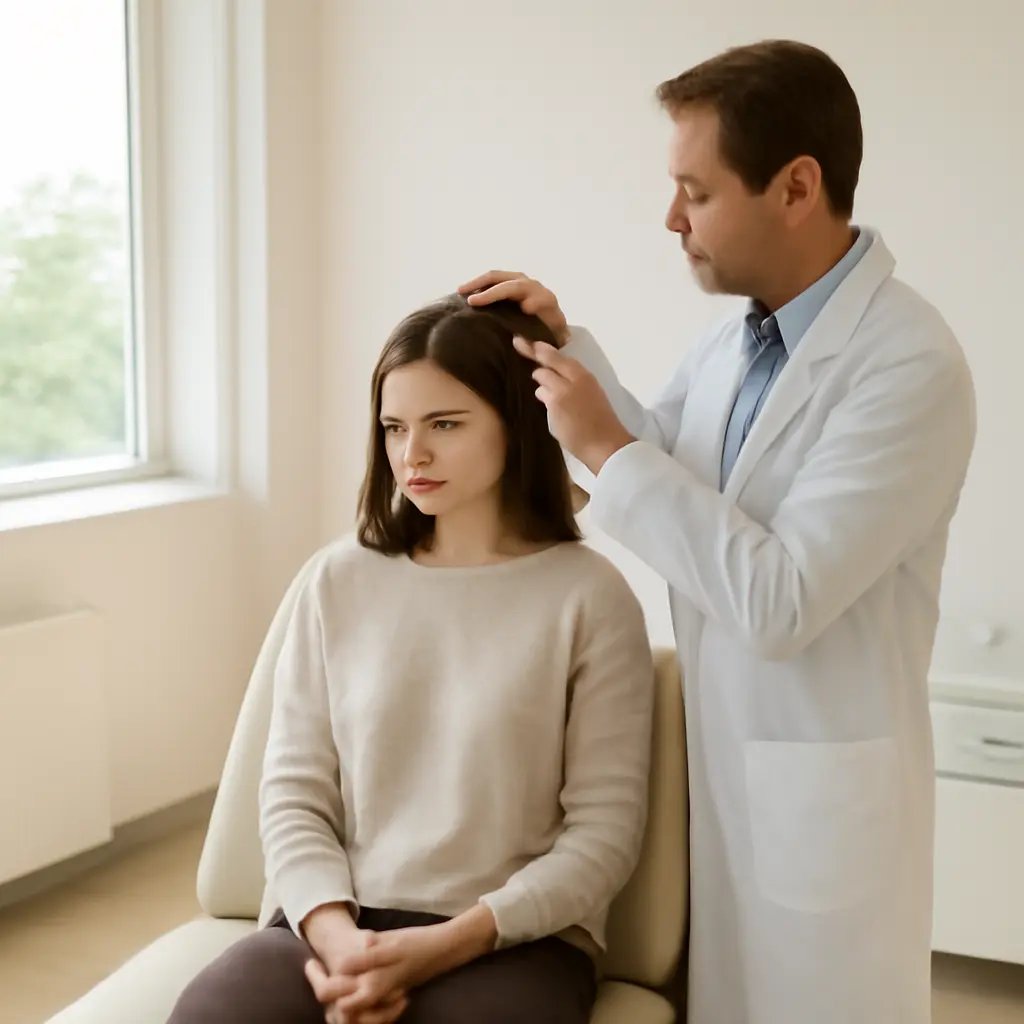
A scalp examination evaluates whether loss is diffuse or concentrated in particular areas, whether follicles appear intact, and whether there is redness, scale, scarring, or inflammation. TE usually causes shedding across the scalp rather than a sharply defined bald patch. A clinician may inspect the hair shafts and scalp with a dermatoscope, a magnifying instrument that can help reveal signs of patterned hair loss or other scalp disorders.
A hair-pull test may be used as one part of the examination: the clinician gently pulls a small group of hairs to see whether an unusually large number release. Results depend on recent washing and brushing and can vary, so the test does not diagnose TE by itself. The British Association of Dermatologists’ patient guidance likewise emphasizes clinical assessment and finding a possible cause rather than relying on a single test.
Laboratory tests investigate treatable contributors
Blood tests are selected according to a person’s history, symptoms, examination, and risk factors. There is no universal TE panel that every patient needs. Commonly considered tests include a complete blood count, iron studies such as ferritin, and thyroid tests; additional tests may be appropriate when the history suggests a nutritional deficiency, hormonal issue, or systemic illness.
Complete blood count and iron studies check for anemia and low iron stores
A complete blood count (CBC) measures red blood cells and related indicators, helping clinicians assess anemia and other blood abnormalities. Ferritin estimates the body’s stored iron, while other iron studies can help clarify whether iron deficiency is present. These tests can be particularly relevant when there is heavy menstrual bleeding, pregnancy or recent childbirth, a low-iron diet, gastrointestinal symptoms, or a history of iron deficiency.
A low ferritin result may prompt assessment and treatment of iron deficiency, but there is no single universally accepted ferritin threshold that proves iron deficiency is causing hair shedding. The result must be interpreted with the CBC, symptoms, medical history, and laboratory reference range. Iron supplements should not be started at high doses without medical advice because unnecessary iron can cause harm.
Thyroid tests assess a possible endocrine trigger
Thyroid-stimulating hormone (TSH), sometimes paired with free thyroxine (free T4), helps assess whether an underactive or overactive thyroid could be contributing to shedding. Thyroid disease may also cause symptoms such as changes in energy, temperature sensitivity, weight, bowel habits, or heart rate, though symptoms vary. A thyroid result is interpreted in context; a normal test does not confirm TE, and an abnormal one does not automatically establish that it explains all hair loss.
Nutrient, hormone, and other tests depend on individual clues
Tests for vitamin B12, folate, zinc, vitamin D, or other nutrients may be considered when dietary history, symptoms, malabsorption, or examination findings make a deficiency plausible. Broad testing without a clinical reason can produce incidental or difficult-to-interpret results. The AAD advises patients to discuss supplements with a dermatologist, since excessive intake of some nutrients—including vitamin A or selenium—can itself contribute to hair loss.
Hormone testing is not routine for every person with diffuse shedding. It may be considered when there are signs such as irregular periods, increased facial or body hair, severe acne, or other features that suggest a hormonal condition. Tests for autoimmune disease, infection, or other systemic causes are generally guided by specific symptoms and examination findings rather than ordered automatically.
Differential diagnosis determines whether further procedures are needed
Diffuse shedding has several possible explanations, and more than one can occur at once. A dermatologist considers whether the pattern fits TE, female- or male-pattern hair loss, alopecia areata, breakage, or an inflammatory or scarring scalp disorder. The distinction matters because treatment and expected regrowth differ.
Trichoscopy and hair-shaft assessment clarify the pattern
Trichoscopy is magnified examination of the scalp and hair. It can help identify variation in hair-shaft diameter associated with pattern hair loss, broken hairs, or features suggesting other diagnoses. In TE, clinicians look for diffuse shedding without a distinctive scarring pattern; however, trichoscopy is an aid to clinical judgment, not a standalone proof of the cause.
Clinicians may also examine shed hairs for features such as a club-shaped root, which is consistent with a hair that has completed the telogen phase. The appearance of a shed hair alone cannot establish why it entered that phase, so it is interpreted alongside timing, scalp findings, and medical history.
Scalp biopsy is reserved for unclear or atypical cases
A scalp biopsy removes a small sample of skin for microscopic examination. It is not usually needed when the history and examination fit straightforward acute TE. A dermatologist may consider it when shedding is persistent, the diagnosis remains uncertain, or there are signs of scarring, inflammation, or another disorder that requires different treatment.
A biopsy can help distinguish among hair-loss patterns, but it is a procedure with limitations and should be ordered only when the result is expected to change clinical decisions. A normal-looking scalp and a typical delayed shedding pattern often provide enough information to proceed without biopsy.
Recovery follows the hair cycle and the underlying cause
In many acute cases, shedding eases after the trigger has passed or been addressed. The AAD notes that hair often returns to its usual fullness within six to nine months, while the British Association of Dermatologists describes acute TE as commonly settling within several months. These estimates describe typical courses; regrowth is gradual because new hairs must grow long enough to become visible.
Addressing the trigger supports recovery
Care depends on the cause: treating a confirmed thyroid disorder, correcting a documented nutritional deficiency, or managing an underlying illness may be appropriate. When no ongoing trigger is found, reassurance and observation may be sufficient. Gentle hair care can reduce breakage, but shampoos and styling changes do not remove the underlying hair-cycle trigger.
A practical example is shedding that begins a few months after a high fever. If the history and scalp examination fit TE and targeted tests do not reveal another issue, the clinician may explain the expected delay and monitor recovery rather than ordering extensive testing. By contrast, shedding accompanied by fatigue and heavy menstrual bleeding may justify CBC and iron studies. The appropriate workup depends on the person, not on a fixed checklist.
Persistent shedding deserves reassessment
Chronic TE generally refers to shedding that continues or recurs for more than six months. In that situation, clinicians revisit the timeline and look for ongoing triggers, medication effects, nutritional issues, thyroid disease, or coexisting pattern hair loss. Noticeable bald patches, scalp pain, marked redness or scale, eyebrow loss, or signs of scarring are reasons to seek medical assessment sooner rather than assuming the problem is uncomplicated TE.
Photographs taken under similar lighting and from the same angles can help track change over time, although they do not replace examination. Patients can also record the onset of shedding, major health events, medication changes, and any associated symptoms to make follow-up more useful.
Conclusion: testing guides the path from shedding to regrowth
Doctors evaluate telogen effluvium through the relationship between a delayed onset of diffuse shedding and a possible trigger, supported by scalp examination and selectively chosen tests. CBC, ferritin and other iron studies, and thyroid testing are common considerations, while nutrient, hormone, or other investigations depend on individual clues. Trichoscopy and, less often, scalp biopsy help when the pattern is unclear or atypical.
Because TE is usually temporary but can resemble other conditions, the most useful next step is a clinician-guided assessment rather than self-diagnosis or indiscriminate supplement use. Seek medical advice for persistent or worsening shedding, visible patches, scalp inflammation, or symptoms that suggest an underlying illness. Keep a timeline of health events and treatments, and ask which test result would change the care plan.
Sources: American Academy of Dermatology, “Telogen effluvium: Overview,” https://www.aad.org/public/diseases/hair-loss/causes/telogen-effluvium; British Association of Dermatologists, “Telogen Effluvium,” https://www.bad.org.uk/pils/telogen-effluvium/; Cleveland Clinic, “Telogen Effluvium,” https://my.clevelandclinic.org/health/diseases/24486-telogen-effluvium; DermNet, “Telogen effluvium,” https://dermnetnz.org/topics/telogen-effluvium.